BLOG
WELCOME TO THE PINK UMBRELLA BLOG
Thought leadership, news and views.
THE HIDDEN COST OF CHASING LEADS
And starving your brand....
By Michelle Boland
March 2026
We all know the story
> Revenue dips.
> Pipeline looks thin.
And someone says, “We just need more leads.”
So budgets move.
Brand gets cut.
Demand generation is parked.
Everything flows into short-term lead capture.
It feels rational. It feels commercial. It feels measurable.
It is none of those things. It’s actually one of the most expensive mistakes a business can make.
Here's what the evidence actually says
Les Binet and Peter Field’s work for the IPA analysed hundreds of campaigns over decades. Their conclusion was blunt:
- Long-term brand building drives profit growth.
- Short-term activation drives immediate sales.
- The strongest results come from a balance of both.
Their research suggests an approximate 60:40 split in favour of brand for sustained growth in many categories. They called it 'the long and the short of it'.
Ignore brand, and your growth plateaus
The Ehrenberg-Bass Institute reinforces this. Growth comes from increasing mental and physical availability. In simple terms:
- Buyers need to remember you.
- And they need to be able to find you.
Lead generation only works on the second half of that equation.
If you are not investing in memory structures, distinctive assets, and broad reach, you are competing for a shrinking pool of in-market buyers.
And that pool is smaller than most leadership teams realise.
LinkedIn’s B2B Institute has repeatedly shown that only around 5 percent of buyers are “in market” at any one time in many B2B categories. The other 95 percent will buy later.
If you are only targeting the 5 percent, you are fighting over scraps.
The short-term illusion
When you cut brand, nothing dramatic happens immediately. (It lulls you into a false sense of security...)
- Cost per lead may even improve.
- Spend looks efficient.
- Dashboards look neat.
But slowly:
- Search volume softens.
- Conversion rates weaken.
- Sales cycles lengthen.
You start paying more to convince colder audiences who have no reason to prefer you.
And then leadership concludes that marketing “isn’t working” and doubles down on performance spend.
The cycle is brutal.
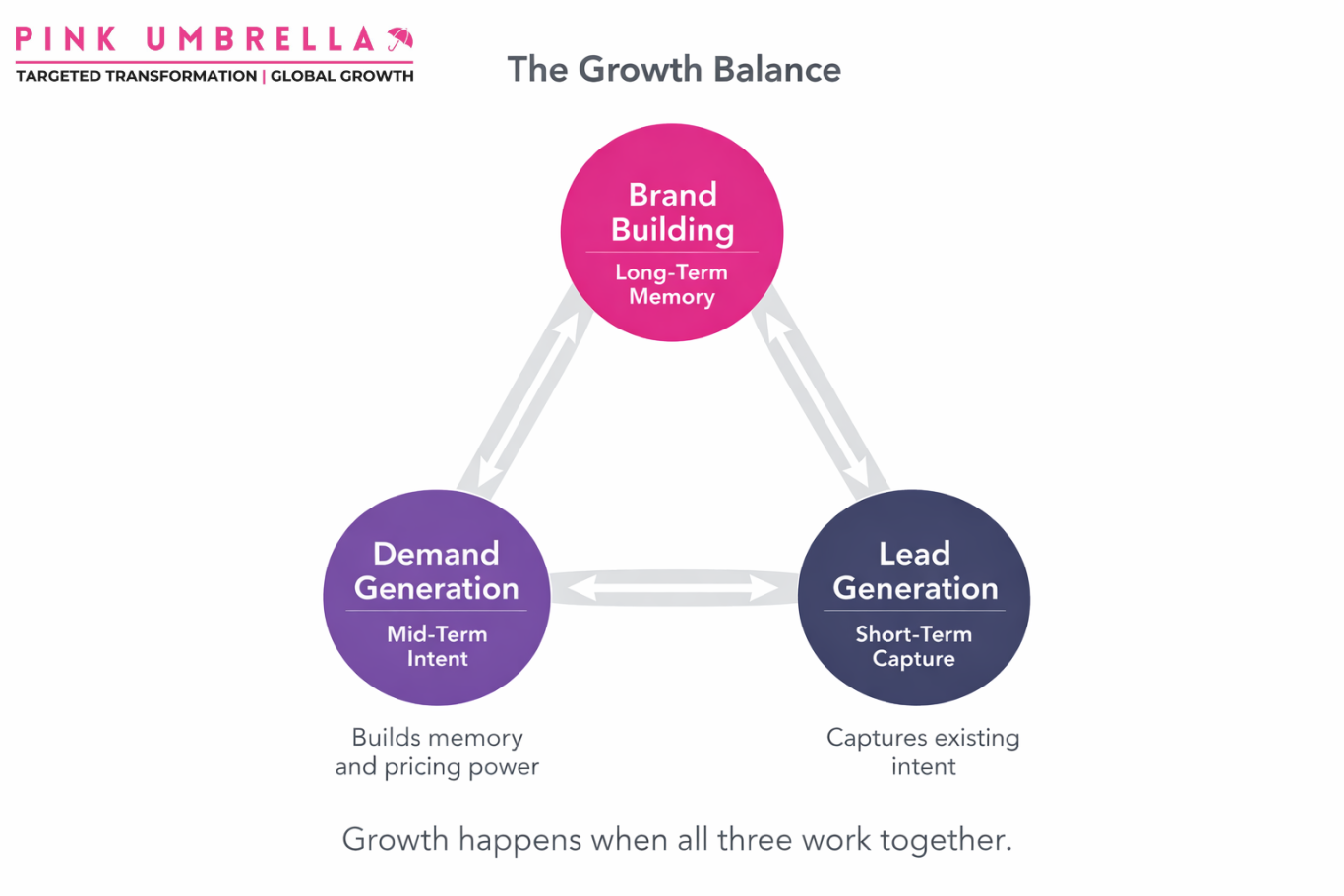
Many organisations treat all marketing as if it should deliver the same thing at the same time. But different types of marketing play different roles in driving growth. Some activities build memory and preference over the long term. Some nurture interest and warm future buyers. And some capture intent when someone is ready to act. When those roles are understood and balanced properly, marketing becomes far more effective - and you realise that you can't just stop one part of the triangle or you create inbalance.
We use a very simple model at Pink Umbrella to show how each part of marketing creates balance and growth, one feeds into the other, and so on. Each part must exist in order to deliver the desired results.
What strong businesses understand
Brand is not fluff. It is commercial infrastructure.
Demand generation is not vague awareness. It is warming future buyers.
Lead generation is the final step, not the whole strategy.
Remove brand and demand, and you force performance marketing to work far harder than it should.
- That drives up cost.
- It erodes margin.
- It weakens pricing power.
Which becomes a board problem very quickly.
Your 4 key takeaways
- Short-term lead generation should sit on top of brand, not replace it.
- If 95 percent of your buyers are not in market today, your job is to stay visible until they are.
- Efficiency today can create fragility tomorrow.
- The real question is not “How many leads did we get?” but “Are we building future demand?”
Finally, some hard questions for your board
If all your performance marketing stopped tomorrow, would enough people still think of you first?
If the honest answer is no, then your growth is more fragile than you think.
Lead generation keeps this quarter alive.
Brand and demand generation protect the next one.
Ignore that balance, and you’ll always be chasing.
THOUGHT LEADERSHIP ISN'T A TACTIC...
It's an outcome.
By Michelle Boland
January 2026
Learn about our 3 step model to help you create successful thought leadership
Every business wants visibility.
Every founder wants to be seen as a leader.
But you don’t get there by “doing thought leadership”.
You get there by doing the work, telling the story, and earning your place.
At Pink Umbrella, we help B2B brands build market position with impact. That includes helping them build strong thought leadership. But we don’t start with a mic or a podcast. We start with value.
Because thought leadership done well builds brand trust, grows preference, and drives demand. But only when it’s built on the right foundation.
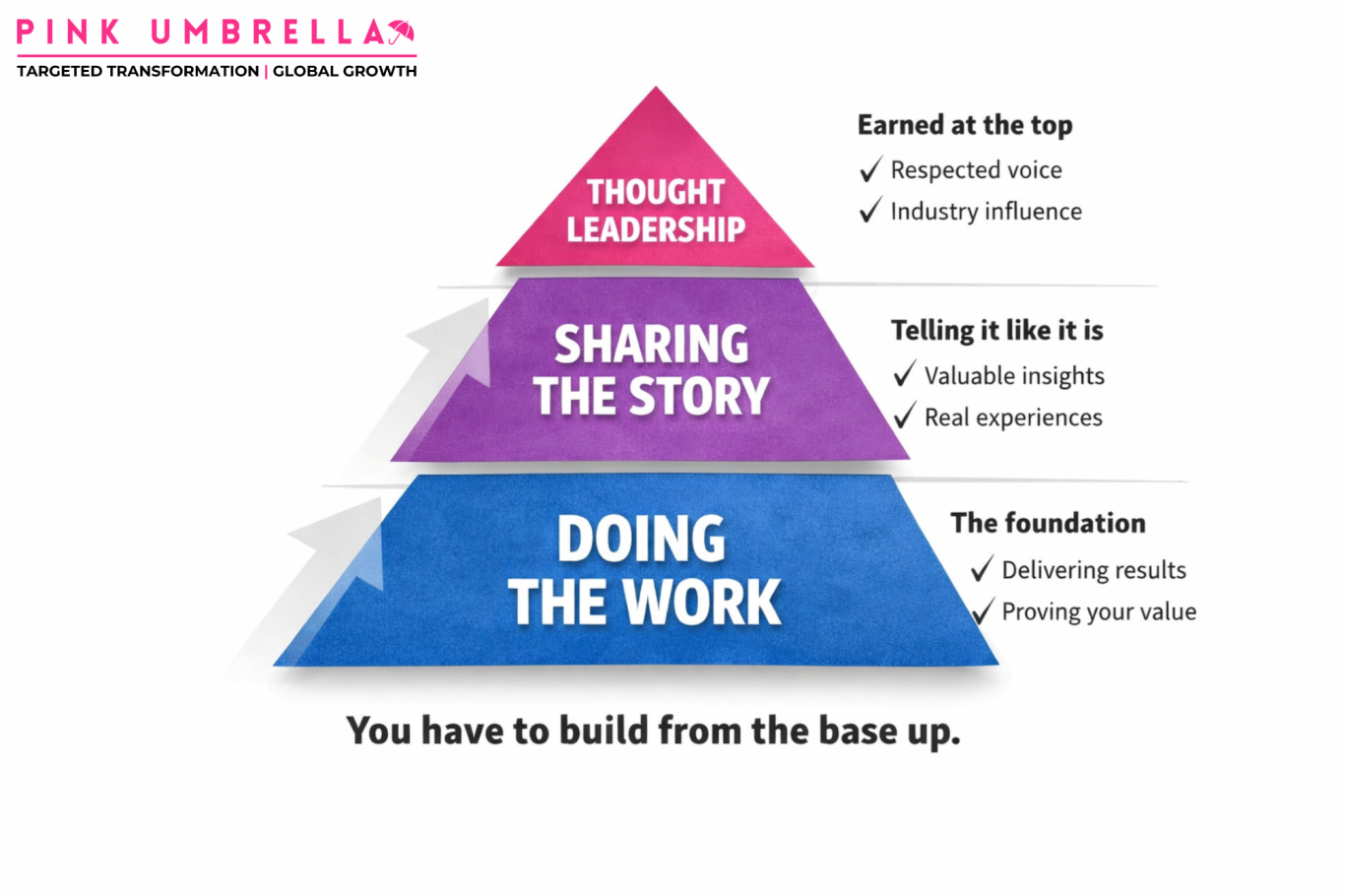
The Thought Leadership Pyramid
We use a simple model to help clients shape and scale their influence. It’s a pyramid – because if you skip the base, nothing lasts.
1. Doing the work
Thought leadership without credibility is just noise.
We start with substance. That means:
• Solving real customer problems
• Delivering impact across marketing, commercial, or leadership
• Understanding what works and what doesn’t in your space
This is the bit people skip. They want the byline, the badge, the audience – but haven’t done the work. The strongest leaders? They speak from experience. That’s the edge.
You can’t build long-term influence without first doing the hard yards.
2. Telling the story
Once you’ve built substance – the next step is to shape the story.
This is where brand building meets audience building.
We help clients distil what they know into something their audience needs to hear:
• Lessons from failure
• Wins with context
• Patterns worth paying attention to
• Frameworks, thinking, and stories others can apply
Not surface-level hot takes. Useful, considered content that shifts how others see the problem.
3. Earning thought leadership
This is the top of the pyramid. And it’s earned.
When you consistently deliver value and insight, your voice starts to carry. You get invited into rooms. You get asked to speak. People quote your work. They link to you. They mention you in their boardroom. That’s the goal.
True thought leadership shapes conversations and drives action.
It’s not a content type. It’s not a funnel stage. It’s the result of aligned expertise, consistent delivery, and a strong point of view.
Why it matters now
In a noisy market, authority matters.
B2B buyers want to work with brands that:
• Understand the problem better than they do
• Can articulate solutions clearly
• Are trusted by others in their space
Done well, thought leadership builds brand equity, strengthens commercial conversations, and drives high-intent demand.
That’s why we build it from the ground up – not as a vanity play, but as a long-term growth lever.
Build your brand from the base
We help B2B businesses, scaling brands and consultancies:
• Identify what they stand for
• Uncover the stories worth telling
• Develop a content system that supports brand and demand
• Turn internal expertise into external influence
We build from the base. That’s how you earn a voice that sticks.
Want help shaping your brand’s point of view?
We work with founders, marketing leaders, and senior teams to build clarity, visibility, and impact.
Transformation Isn’t Just One Thing
Unlock the secrets here...
By Michelle Boland
August 2025
When most people talk about “transformation,” what they really mean is one of two things:
- A shiny new system that was meant to solve everything.
- Or a restructure that gave everyone a new job title and very little else.
Neither is transformation.
Real transformation is broader. It’s messy. And it cuts across the whole business – not just marketing, not just ops, not just tech.
The uncomfortable truth? If you ignore one area, the others creak.


Where transformation actually shows up
Sometimes it’s teams.
You’ve got people duplicating work. Meetings about meetings. Layers of sign-off that slow everything down. Salary bills climbing while output flat-lines. Team transformation isn’t about cutting heads – it’s about redesigning the structure so people actually own something and work connects back to outcomes.
Other times, it’s technology.
The stack looks great on paper – Salesforce, HubSpot, Tealium, AI tools, you name it – but nothing connects. Data sits in silos, licences gather dust, and the ROI slide never materialises. Tech transformation isn’t about the newest tool; it’s about making the existing ones work together so you can actually scale.
Then there are the processes.
Good strategies die in bad processes. Campaigns stuck in approval hell. Teams running in circles because no one knows who signs off. Customers getting a fragmented experience because every department does things differently. Fixing process doesn’t sound glamorous – but it’s often the lever that releases everything else.
And finally – the one most businesses forget – the customer.
You can have the neatest org chart and the smartest tools, but if the experience still feels clunky to the customer, nothing has changed. Transformation has to reach them. That means sharper messaging, smoother journeys, and experiences designed around how they buy – not how your org chart works.
Why this matters
Because transformation isn’t a project. It isn’t a phase. It isn’t a workstream with an end date.
It’s the ongoing job of making the whole engine work – while the car is still on the road - easy right?!
The best companies understand this. They don’t chase vanity projects or throw tech at the problem. They look honestly at where the friction sits, then fix it without breaking ten other things in the process.
The trap most businesses fall into
- They pick one area and ignore the rest. New tech but no processes. New structure but no strategy. Customers forgotten in the rush.
- They focus on surface wins. A new dashboard, a rebrand, a big announcement – while underneath, nothing changes.
- They stop too soon. Transformation isn’t “done” because a system went live. It’s only done when the system is being used, consistently, to deliver growth.
The companies that thrive
They keep questioning. They keep optimising. They see transformation as a web, not a straight line – pull one thread and you need to know what else shifts.
And they understand that growth doesn’t come from a single heroic project. It comes from the combination – teams, tech, processes, customers – working together, better.
'The art isn’t in doing it all at once. It’s in knowing which thread to pull – and when to stop.'
That’s where an outside perspective helps. Someone who’s seen what “good” looks like across different organisations, and knows how to untangle the web without breaking it.
If you’re trying to figure out where to start – or where you’ve stalled – that’s exactly what we do.
Get in touch and see how we can help you make sense of the noice.
THE ULTIMATE GUIDE TO FRACTIONAL CMOs
What they are and why your business needs one
By Michelle Boland
May 2025

What is a fractional CMO – and do you need one?
Not every business needs a full-time CMO.
But most need someone who can bring clarity, commercial thinking, and a proper plan.
That’s where a fractional CMO (FCMO) comes in.
You get senior marketing leadership – the kind that drives growth, aligns teams, and fixes what’s broken – without the £150k+ salary commitment.
It’s part-time support with full-impact thinking.
So, what does a fractional CMO actually do?
- They don’t just advise. They lead.
They partner with founders and boards to make marketing more effective, more focused, and more accountable.
A good one will:
- Build a marketing plan aligned to business goals
- Coach and guide your team – or build it from scratch
- Fix what’s underperforming (from messaging to media spend)
- Align sales, product, and marketing so everyone’s pulling in the same direction
- Focus on performance – not just pretty campaigns
- Measure what matters (and help you stop chasing vanity metrics)
They bring the confidence of experience – without the ego or internal politics.
Why hire a fractional CMO?
Because you need senior marketing firepower – but you don’t want to over-hire, overpay, or waste time.
Fractional CMOs bring:
- Commercial clarity – no fluff, no fluffers, just what drives growth
- Strategic oversight – proper plans, built on insight and data
- Speed – quick wins that build momentum
- Scalability – they design for now and what’s next
- Credibility – they’ve done this before, and it shows
You get exactly what you need – and none of what you don’t.
What type of business are they for?
Fractional CMOs are ideal for:
- Start-ups who need expertise but can’t afford full-time
- Scaling businesses where growth has outpaced structure
- SMEs ready to professionalise their marketing
- Founder-led teams juggling too many hats and needing commercial focus
If marketing feels like it’s happening to you, rather than for you – it’s time to bring in help.
The first 30 days: what to expect
You won’t get a shiny new strategy in week one – and that’s a good thing. First, we need to see what we’re working with.
Expect:
- Discovery and diagnostics – reviewing your plans, tools, team, performance, and messaging
- Quick wins – identifying and fixing easy-to-spot issues that are slowing you down
- An action plan – prioritised steps to get your marketing aligned and set up for growth
This phase is about building foundations – not rushing to fix things with guesswork.
What impact can a fractional CMO have?
They focus on the work that moves the needle.
You’ll see:
- Campaigns that convert
- Teams with clarity
- Spend that delivers ROI
- Messaging that lands
- Metrics that actually tell you something useful
They turn your marketing from a cost centre into a driver of commercial value.
And no – they’re not “just consultants”
They don’t just talk. They do.
A fractional CMO will:
- Embed in your team
- Lead the work
- Execute on strategy
- Coach your people
- Own the outcomes
They show up, get stuck in, and leave your marketing in a better place than they found it.
Signs you might need one
✅ You’re spending money on marketing, but not seeing results
✅ Your team has no senior lead or clear direction
✅ You’re preparing to grow or launch something new
✅ You know you need help – but a full-time hire is out of reach
So, is an FCMO right for you?
If your business needs stronger marketing but doesn’t need a full-time CMO, this is your sweet spot.
A fractional CMO gives you the thinking, leadership, and commercial rigour – with none of the long-term overhead.
Want to know if it’s a fit?
Let’s talk. Pink Umbrella gives you flexible, experienced, and results-led marketing leadership - designed around your business, not someone else's playbook.