CASE STUDIES
▸ CASE 1:
B2B, D2C MARKETING AND BRAND STRATEGY
Transforming A Sports Therapy Clinic’s Marketing Approach
Client Profile
A sports therapy and chiropractic clinic in Buckinghamshire, now in its second year post start-up. Experiencing consistent growth with a 15% year-on-year increase, the business sought scalable marketing solutions to streamline operations and drive higher conversions.
Objectives
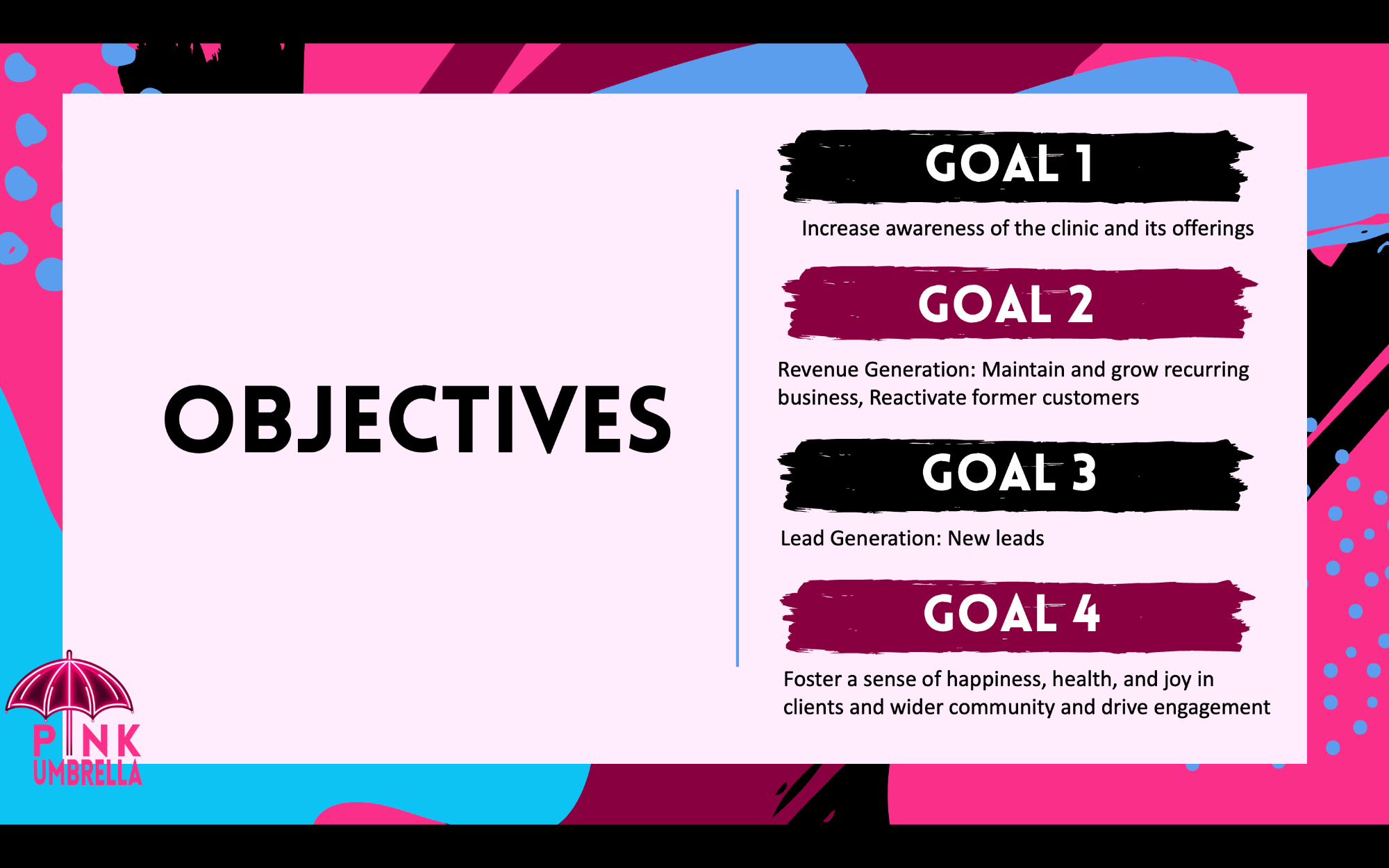
The client engaged Pink Umbrella to:
- Review all existing marketing and brand plans.
- Revise strategy for better alignment with overall business objectives.
- Conduct a Martech and AI audit to identify gaps and future needs.
- Optimise content planning and creation for efficiency and impact.
- Increase brand awareness
- Incrase lead generation
- Revenue generatuion (maintain and grow)
- Bring the values of the business to the community
Approach
Through a series of in-depth workshops and strategic reviews, we:
- Redesigned the Marketing Strategy: Evaluated current plans and processes to create a roadmap tailored to the client’s growth trajectory.
- Executed a Martech Audit: Transitioned the client from manual processes in Excel to Mailchimp CRM, integrating email marketing functionality with AI tools like ChatGPT to generate personalised messaging at scale. Automated workflows improved customer segmentation and journey mapping.
- Streamlined Content Creation: Introduced the 70/30 Rule, where 30% of the client’s time was spent creating new content, while 70% focused on repurposing and redistributing existing materials. Tools like Canva and Hootsuite were used to enhance efficiency and maximise reach.
- Introduced a content calendar: Planned in for the next 12 months.
- Introduced email marketing: Including the use of a new AI practices, CRM and Email marketing tech.
- Introduced funnel analysis: To fous the mind on closing leads from consideration and onwards.
- Enhanced Lead Closure: Utilised Mailchimp’s AI-powered email automation to personalise customer journeys, creating targeted campaigns for lead nurturing, appointment reminders, and post-visit follow-ups.


Results
The strategy and technology integration are already driving transformative success:
- Content Efficiency: Saved one full day per week on content creation by repurposing and automating processes.
- Social Media Growth: Achieved a 350% increase in social referrals through optimised, consistent posting and engagement strategies.
- Customer Satisfaction: Earned 100% 5/5 reviews on Google, reflecting improved customer experience and communication.
- Community Engagement: Increased community engagement by over 290%, further strengthening brand loyalty and visibility.
- Automated Lead Closure: Achieved an 18% improvement in lead closure rates from a standing start, supported by personalised email workflows.
Projected Outcomes for months 6-12
Based on current performance and industry benchmarks, future results are expected to include:
- A 20–30% increase in lead conversion rates over six months.
- A 40% reduction in manual operational tasks through automation.
- Sustained growth in online reviews and social engagement, enhancing the clinic’s reputation and visibility.
This case study showcases how Pink Umbrella leverages cutting-edge technology, strategic insights, and tailored solutions to drive real results for growing businesses.
Want to see similar results for your business? Contact us to learn more.
▸ CASE 2:
MARKETING OPERATIONS AND BRAND GOVERNANCE
Transforming marketing production in a hyper-growth consumer FinTech business
Client Profile
A fast-scaling fintech business with approximately £50m in annual recurring revenue, operating in a highly competitive consumer market. Experiencing rapid growth and increasing campaign velocity, the business needed its marketing operation to keep pace with strategic ambition - without compromising brand quality or consistency.
Objectives
The client engaged Pink Umbrella to:
- Review current marketing production processes and identify where operations were slowing strategic execution.
- Enable faster, more consistent delivery of campaigns aligned to the growth strategy.
- Reduce reliance on specialist design resource for strategically defined, routine marketing assets.
- Maintain consistent brand standards across all marketing and sales materials.
- Build a scalable system allowing teams across the business to execute approved, strategy-led assets independently.
- Ensure all messaging remained aligned with approved brand language and commercial objectives.
Approach
Through a structured operational review and implementation process, we:
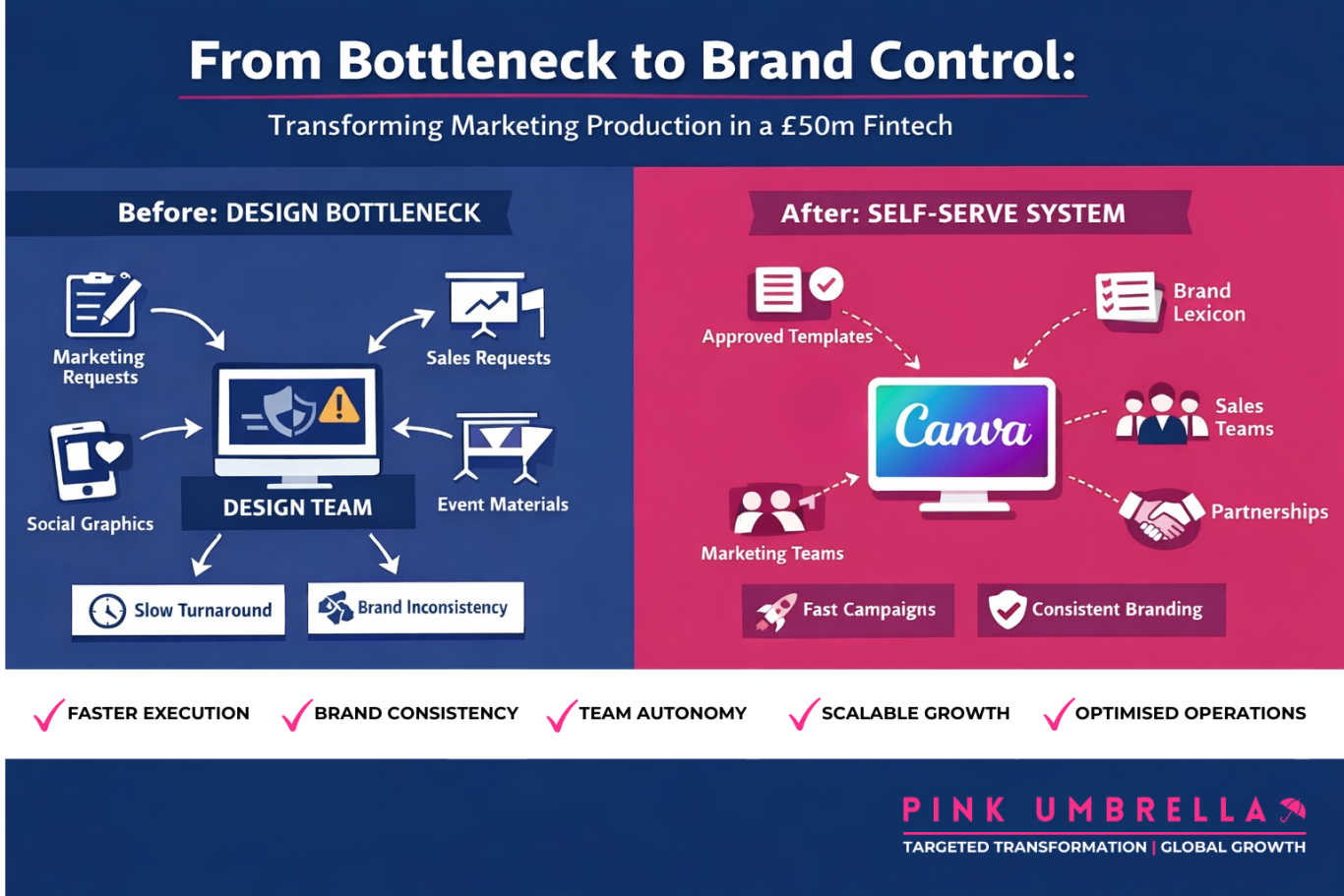
- Diagnosed the production bottleneck: Identified that the marketing strategy was being held back by operational constraints, not a lack of ideas. Design requests - campaign assets, sales materials, customer communications - were all flowing through a small design team. Execution was slow. Strategic momentum was being lost to production queues.
- Aligned the system to the strategy: Before building anything, we mapped the production system to the strategic priorities. Every template, every approved asset, every messaging framework was built to serve a defined strategic output - not to generate volume for its own sake.
- Implemented a self-serve production environment: Introduced Canva as a structured, strategy-led production system. Non-design teams could produce the right assets quickly, with brand standards protected and strategic intent built in.
- Built brand-locked templates: Created a library of pre-approved templates directly tied to strategic campaign and channel requirements - social media graphics, PPC ad variants, sales presentation slides, email visuals, and partnership materials. Colours, fonts, and layouts were locked to protect brand integrity and ensure every asset served its intended purpose.
- Introduced a brand lexicon: Developed a structured library of approved messaging aligned to commercial objectives. Key product descriptions, brand phrases, tone-of-voice guidance, and messaging frameworks - so every communication, whoever produced it, stayed strategically consistent.
- Enabled cross-team autonomy: Trained teams across marketing, sales, and partnerships to work within the system. Speed came from clarity - everyone knew what to produce, how to produce it, and why.
Results
The system delivered because it was built around strategic need, not production volume:
- Strategic execution speed: Campaign assets could be produced and deployed at pace, directly in support of the growth strategy. PPC ad variants were built and A/B tested quickly, contributing to a 224% increase in daily average lead generation alongside the broader marketing strategy.
- Engagement: Consistent, strategy-aligned content and campaign output drove a 45% increase in audience engagement across channels.
- Brand consistency: All internal teams produced assets within the same visual and messaging standards, protecting brand equity as the business scaled.
- Design resource optimisation: Specialist designers were freed from routine production, allowing them to focus on higher-value strategic creative work.
- Operational scalability and cost efficiency: Marketing output increased in line with strategic demand - without adding headcount or external design spend. Through AI optimisation and SOP transformation, the equivalent of two full-time roles were absorbed into the new system, delivering salary cost savings of over £100k annually.
Projected outcomes for months 6 - 12
Based on initial adoption and performance, the system is expected to deliver:
- Continued strategic campaign execution at pace, without production becoming a constraint.
- Sustained lead generation growth supported by faster, more consistent asset deployment.
- Greater cross-team autonomy within clear strategic and brand guardrails.
- Ongoing cost savings through reduced reliance on external design support.
This case study shows how Pink Umbrella helps high-growth businesses build marketing operations that serve their strategy - keeping teams moving at the speed the business needs, while protecting brand quality and commercial focus.
This case study showcases how Pink Umbrella helps high-growth businesses build marketing operations that serve their strategy - keeping teams moving at the speed the business (and market) needs, while protecting brand quality and commercial focus.
Want to see similar results for your business?
WANT A CHAT?
Looking to learn more? We'd love to hear from you! Either email michelle@pinkumbrella.co.uk, or complete the contact form below.